Best RTX 5070 Ti Graphics Cards 2026
The best RTX 5070 Ti AIB cards ranked by cooling, noise, overclocking, and value, from ZOTAC Solid Core to MSI Trio to Gigabyte Gaming OC. Expert picks, pros...
As an Amazon Associate we earn from qualifying purchases made through our links — this doesn't affect our picks.
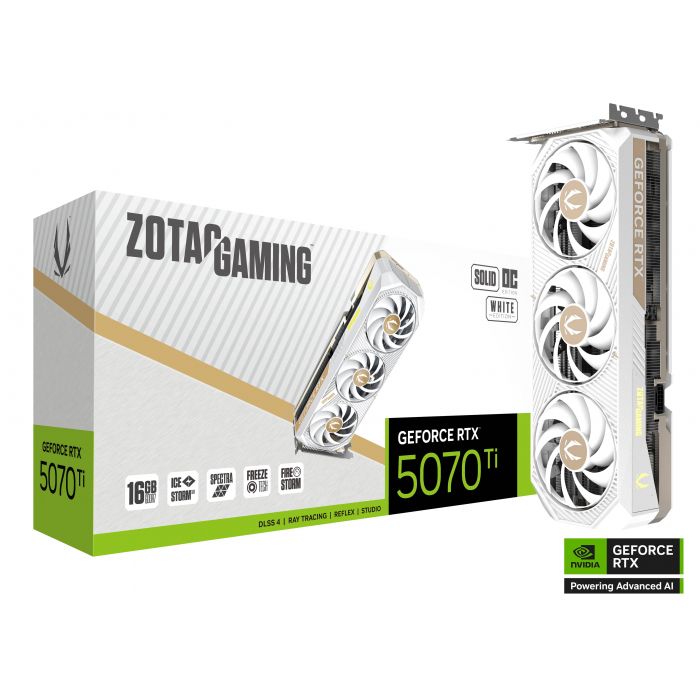
ZOTAC GAMING GeForce RTX 5070 Ti SOLID CORE OC White Edition 16GB GDDR7
Our top recommendation for this category
Price as of May 25, 2026 — see current price on Amazon.
The RTX 5070 Ti launched at $749 MSRP and promptly became impossible to find at that price. Street prices peaked around $1,220 before finally cooling off. Right now you can find most cards in the $900–$1,100 range, and the value math starts making sense again, especially compared to shelling out an extra $300 for an RTX 5080 that's only 15% faster.
Here's the thing though: the GPU underneath all these cards is identical. Same GB203 silicon, same 8,960 CUDA cores, same 16GB GDDR7. What you're actually buying is the cooling solution, the noise floor, the PCB quality, and whether the card will thermally throttle at 3 AM during a long Cyberpunk session. Some of these differ by a lot. Reviewer data from Hardware Unboxed, ThePCEnthusiast, and Tom's Hardware thermal benchmarks shows which RTX 5070 Ti variant is actually worth your money.
At a Glance
| Card | Boost Clock | Cooling | Noise (dBA) | Approx. Price | |
|---|---|---|---|---|---|
| ZOTAC Solid Core OC White | 2,482 MHz | 2.5-slot vapor chamber | Not published | $1,345 | Check Price |
| MSI Gaming Trio OC Plus | 2,580 MHz | TRI FROZR 4, 3 fans | 31 dBA | $1,049 | Check Price |
| Gigabyte Gaming OC | 2,588 MHz | WINDFORCE 3x | 33 dBA | $1,099 | Check Price |
| ASUS TUF Gaming OC | 2,610 MHz | 3.125-slot Axial-Tech | 30 dBA | $1,069 | Check Price |
| Zotac AMP Extreme Infinity | 2,572 MHz | IceStorm 3.0, 3 fans | 34 dBA | $999 | Check Price |
ZOTAC GAMING GeForce RTX 5070 Ti SOLID CORE OC White Edition
Most of the cards on this list are 3.1 to 3.2 slots thick. The ZOTAC Solid Core OC is a 2.5-slot design at 304 mm long, and it still gets a vapor chamber under its IceStorm 3.0 triple-fan cooler. That combination is the reason it leads this list: it's the 5070 Ti most likely to drop into the case you already own without a clearance headache, and it doesn't trade away a serious cooler to get there.
The factory boost is 2,482 MHz, a mild bump over Nvidia's reference clock. That's lower than the ASUS and MSI cards below, but the GPU underneath is the same GB203 chip, so in real games the gap is a few frames at most. Board power is 300W through a single 16-pin connector, and ZOTAC lists a 750W supply as the minimum, which matches what most mid-to-high-end builds already have.
The White Edition is the version carded here: white shroud, white backplate, and a GPU support stand in the box. If you're building around a white case, it saves you hunting for a matching card. The catch is price. At $1,345 it isn't the cheapest way onto a 5070 Ti, so if your case has room for a 3-slot card and color doesn't matter, the value picks below are worth a look.
ZOTAC GAMING GeForce RTX 5070 Ti SOLID CORE OC White Edition 16GB GDDR7
Pros
- 2.5-slot, 304 mm design fits more cases than 3-slot cards
- Vapor chamber with IceStorm 3.0 triple-fan cooling
- Matching white shroud and backplate for white builds
- GPU support stand included
Cons
- 2,482 MHz boost is the lowest factory clock here
- Not the cheapest 5070 Ti on this list
- Single 16-pin power connector needs a native cable or adapter
Price as of May 25, 2026 — see current price on Amazon.
MSI Gaming Trio OC Plus RTX 5070 Ti
MSI's Gaming Trio OC Plus sits at a compelling sweet spot for most buyers. It uses MSI's fourth-generation TRI FROZR 4 cooling with three 95mm STORMFORCE fans, and thermal performance is strong without the physical bulk of the biggest 3.2-slot designs. Max temperature in sustained workloads comes in around 65°C, still excellent, and noise stays around 31 dBA, which is quiet enough that you won't notice it over ambient noise at a reasonable fan curve.
MSI's FROZR fans have a zero-RPM mode below 60°C, so for light gaming and browsing the card is completely silent. With the fans stopped, that means actually silent, not "you can barely hear it" quiet. The TORX Fan 5.0 design pulls airflow directly over the GPU die rather than brute-forcing high RPM to compensate for mediocre airpath design. This is a card built to be used, not babied.
The boost clock at 2,580 MHz is on the modest side compared to the fastest factory-overclocked cards, but the performance difference in actual games amounts to 1-2 FPS at most. Not something you'd feel. The TRI FROZR 4 cooler and strong PCB also make it a real OC platform. Push it with MSI Afterburner and you've got room to work. This is the card I'd send most people to.

MSI Gaming GeForce RTX 5070 Ti 16G Gaming Trio OC Plus
Pros
- Excellent TRI FROZR 4 triple-fan cooling
- Zero-RPM mode for silent idle operation
- Strong price-to-performance ratio
- Solid OC headroom on good PCB
Cons
- Boost clock slightly lower than the ASUS TUF
- RGB implementation is less configurable than some
Price as of May 25, 2026 — see current price on Amazon.
Gigabyte GeForce RTX 5070 Ti Gaming OC 16G
Gigabyte's Gaming OC is the card you consider when you want solid performance and you're not paying premium prices for premium cooling. The WINDFORCE 3x cooling system with alternate-spinning fans keeps temps around 67°C under load, which is perfectly acceptable. Where it falls short is noise: it's louder than both the MSI Trio and the ASUS TUF, at around 33 dBA.
The boost clock hits 2,588 MHz, which is nearly identical to the MSI Trio. Gigabyte's dual BIOS is a nice feature: one quiet mode profile and one performance profile, switchable via a physical button on the card. Not everyone uses it, but it's a genuinely useful option if you share a room with your rig.
Where Gigabyte earns its place here is consistency. At around $1,099, it's one of the better-priced options from a major brand with a proper triple-fan cooler. The card isn't flashy and it's not trying to be. Gigabyte's been building solid mid-tier AIBs for years and this continues that track record without drama. Just go in knowing the noise level is higher than MSI or ASUS. That's the real tradeoff here, not performance.

Gigabyte GeForce RTX 5070 Ti Gaming OC 16G
Pros
- Dual BIOS with quiet/performance mode switch
- Solid triple-fan WINDFORCE cooling
- Reliable build quality from major brand
- 2,588 MHz OC factory setting
Cons
- Louder than MSI and ASUS at 33 dBA
- No zero-RPM idle mode
- Less aggressive cooling than top-tier picks
Price as of May 25, 2026 — see current price on Amazon.
ASUS TUF Gaming GeForce RTX 5070 Ti OC
The ASUS TUF is a card I keep recommending to builders who want ASUS quality without paying for ASUS's flagship tier. It uses a 3.125-slot cooler with Axial-tech fans, the same fan architecture ASUS puts on its premium cards. Temperatures peak around 62°C under sustained gaming, and noise sits at a respectable 30 dBA. It genuinely punches above its price.
ASUS specifies military-grade components and a protective PCB coating, which matters if you're in a dusty or humid environment. The TUF line has a reputation for longevity: the binning standards aren't as aggressive as on ASUS's flagship cards, but the build durability holds up well for everyday use.
The boost clock at 2,610 MHz is actually higher than both the MSI Trio and Gigabyte Gaming OC, which was a surprise. In practice that translates to performance closer to the flagship-tier cards than most people expect for the price. If I were building a mid-to-high-end rig and wanted ASUS build quality without the flagship premium, this is exactly where I'd land.

ASUS TUF Gaming GeForce RTX 5070 Ti OC Edition 16GB GDDR7
Pros
- 2,610 MHz boost, faster than MSI and Gigabyte
- Military-grade components and PCB coating
- Quieter than Gigabyte at 30 dBA
- ASUS build quality without flagship-tier pricing
Cons
- Slightly bulkier than it looks on paper (3.125 slots)
- Thicker than the 2.5-slot ZOTAC Solid Core
Price as of May 25, 2026 — see current price on Amazon.
Zotac Gaming GeForce RTX 5070 Ti AMP Extreme Infinity
The Zotac AMP Extreme Infinity is the budget-leaning pick here. At around $999, it's the most affordable triple-fan RTX 5070 Ti from a recognized brand on Amazon right now. The IceStorm 3.0 cooling with three fans keeps temperatures reasonable (peak around 69°C), though it runs louder than any other card on this list at about 34 dBA.
Zotac's Spectra 2.0 ARGB lighting is genuinely nice-looking, and the card comes with DLSS 4 support and all the Blackwell perks you'd expect. The 2,572 MHz boost is near the bottom of this group, but again, we're talking 1-3 FPS differences in real games. The actual GPU is the same chip.
Look, honestly, if your goal is to spend as little as possible on an RTX 5070 Ti from Amazon with Prime delivery and a real warranty, Zotac gets you there. The noise level is the real tradeoff. If your case has good airflow and you use headphones, you probably won't care. If you're gaming in a quiet room without audio, those 34 dBA are going to be audible.

Zotac Gaming GeForce RTX 5070 Ti AMP Extreme Infinity 16GB GDDR7
Pros
- Most affordable triple-fan 5070 Ti on this list
- Spectra 2.0 ARGB lighting looks great
- Full DLSS 4 and Blackwell feature set
- IceStorm 3.0 three-fan cooling
Cons
- Loudest card here at 34 dBA under load
- Second-lowest factory boost clock here at 2,572 MHz
- Less premium component binning vs ASUS/MSI
Price as of May 25, 2026 — see current price on Amazon.
What to Know Before Buying
Is the RTX 5070 Ti worth it in 2026?
At MSRP of $749, yes: it's an excellent high-end GPU. At current street prices of $900-$1,200, the math gets trickier. For 1440p gaming with a high-refresh monitor, it delivers strong native performance and becomes genuinely transformative with DLSS 4 Multi-Frame Generation enabled. Tom's Hardware testing showed 4K performance jumping from around 68 FPS native in demanding titles to over 200 FPS with MFG active.
The card beats the last-gen RTX 4080 Super in rasterization by roughly 20-25% and is about 28% faster than the RTX 4070 Ti Super at 4K. If you're upgrading from a 3000-series or older card, the generational leap is enormous.
How does it compare to the RTX 5080?
The RTX 5080 is roughly 15% faster than the 5070 Ti, but carries a 33% higher price tag in most configurations. That math doesn't work out well for most buyers. The exception is if you're gaming at native 4K without DLSS, or you're doing heavy compute workloads where the additional VRAM bandwidth of the 5080 makes a difference. For pure 1440p gaming, the 5070 Ti wins on value by a wide margin.
Which form factor should I pick?
Most of these cards are triple-fan designs ranging from 3.1 to 3.2 slots. Check your case's GPU clearance and slot count before ordering. Mid-tower ATX cases from Fractal, Lian Li, and NZXT in the last two years handle these without issues. Smaller mATX cases may struggle with 3.2-slot designs. If you're in a tighter chassis, look at the 2.5-slot ZOTAC Solid Core OC at the top of this list, Zotac's SFF variants, or the ASUS TUF's 3.125-slot design.
Do I need a new power supply?
The RTX 5070 Ti has a 285W TDP, meaningfully lower than the RTX 4090's 450W. A quality 750W PSU handles an RTX 5070 Ti system comfortably. If you're pairing it with a high-end CPU like a Ryzen 9 9900X or Core Ultra 9 285K, 850W gives you more headroom. Stick to units from Seasonic, EVGA, Corsair, or be-quiet! Cheap power supplies are not where you cut corners on a $1,000 GPU.
What about DLSS 4 and Multi-Frame Generation?
DLSS 4 with Multi-Frame Generation (MFG) is exclusive to Blackwell GPUs, the RTX 50 series. It can generate up to 4 additional frames per displayed frame, effectively quadrupling frame rates in supported titles. At 1440p, a 5070 Ti pushing 90 FPS native can deliver 300+ FPS with MFG enabled. Game support is expanding rapidly, and Nvidia's Reflex 2 integration reduces the latency penalty that older frame generation implementations introduced. It's genuinely impressive tech, and it's a real reason to pick this over an older GPU with better rasterization per dollar.
Frequently asked questions
- What's the best RTX 5070 Ti for most buyers?
- The MSI Gaming Trio OC Plus hits the best balance of cooling, noise, and price at around $1,049. The ASUS TUF Gaming OC is a close second and sometimes runs cheaper: both are cheaper practical choices than the ZOTAC Solid Core OC White, which earns its spot by fitting slimmer cases and white builds.
- Is the RTX 5070 Ti good for 4K gaming?
- Yes, especially with DLSS 4 active. Native 4K in demanding titles like Cyberpunk 2077 runs around 60-70 FPS depending on settings, which is decent but not thrilling. Enable DLSS Quality mode and that jumps to 90-120 FPS with minimal visual difference. Add MFG and you're looking at 200+ FPS in 4K in many titles.
- What CPU pairs well with the RTX 5070 Ti?
- The Ryzen 7 9700X and Intel Core Ultra 7 265K are the practical sweet spots. Both eliminate CPU bottlenecks at 1440p and most 4K scenarios without overpaying for cores the GPU can't use. A Ryzen 9 9900X or Core Ultra 9 285K makes sense if you also do content creation, but for pure gaming it's overkill.
- Does the RTX 5070 Ti run hot?
- Not particularly. With a triple-fan AIB cooler, expect roughly 62-70°C under sustained gaming load depending on the model. The ASUS TUF sits at the cool end (62°C), the Zotac AMP Extreme at the warmer end (69°C). All of these are well within safe operating ranges. Nvidia specifies a max junction temperature of 90°C.
- Is the RTX 5070 Ti better than the RX 9070 XT?
- For most use cases, yes. The 5070 Ti is faster by 15-25% in demanding titles and pulls ahead further with DLSS 4. The RX 9070 XT has a strong value proposition at $549-600 MSRP, but if you're spending $900+ on a GPU, the 5070 Ti makes more sense. AMD's answer would need to be an RX 9080 or higher to match here.
- How many watts does the RTX 5070 Ti use?
- The reference TDP is 285W. Under heavy gaming loads, AIB cards with factory overclocks can hit 300-310W. A quality 750W PSU handles a full gaming rig (CPU plus 5070 Ti plus storage and peripherals) without issue. Go to 850W if you're pairing with a high-TDP CPU like the Core Ultra 9 285K.
Bottom Line
The RTX 5070 Ti is a legitimately excellent high-end GPU: it's just been fighting street prices since launch. As inventory stabilizes in mid-2026 and prices edge closer to MSRP, the value case gets stronger by the week.
For most builders, the MSI Gaming Trio OC Plus at $1,049 is the practical pick. Strong cooler, quiet, well-built, and doesn't ask you to pay a premium for features you probably won't fully utilize. If budget is tighter, the Zotac AMP Extreme Infinity gets you onto the 5070 Ti platform for under $1,000. And if your case is tight on slots or you're building in white, the ZOTAC Solid Core OC White is the one to get: a vapor chamber cooler in a 2.5-slot body.
How We Pick
We pick products by combining spec-level research, price checks, trusted third-party benchmarks, and owner sentiment from high-signal sources.
- Performance and real-world value in the category this guide targets
- Price-to-performance and deal consistency over recent pricing windows
- Build quality, reliability patterns, and known long-term issues
- Recommendation refresh cadence to keep these picks current
Author
TheTechSearch Editorial Team
Independent product reviewers & PC builders
We compare real-world specs, reviews and owner reports, price trends, and user feedback to recommend gear that actually makes sense to buy.