Best Soundbars 2026: Sonos, Samsung, and LG Picks for Every Budget
The best soundbars in 2026, from $99 budget picks to flagship Dolby Atmos systems. Sonos, Samsung, LG, and Amazon compared on performance, features, and value.
As an Amazon Associate we earn from qualifying purchases made through our links — this doesn't affect our picks.
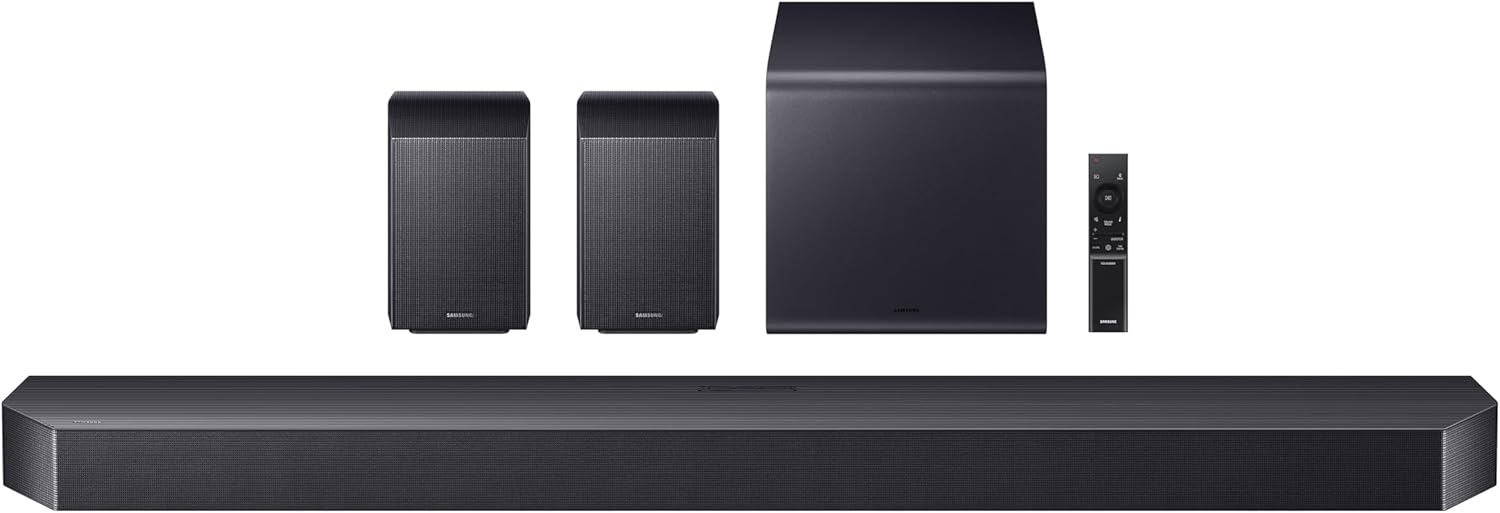
Samsung HW-Q990F 11.1.4ch Soundbar with Rear Speakers and Subwoofer (2025)
Our top recommendation for this category
Price as of Feb 27, 2026 — see current price on Amazon.
Most TVs sound worse than a Bluetooth speaker you'd pick up for $30. The flat cabinets that make modern TVs look great leave almost no room for speakers that actually perform, so manufacturers point them downward or backward and call it a day.
A soundbar fixes that without turning your living room into a cable jungle. The right one adds real bass, height channels for Atmos overhead effects, and dialogue clarity that means you stop fumbling for subtitles every time an actor mutters a line.
The catch is that soundbars range from $99 to over $1,500, and the difference between a mediocre one and a great one is not always obvious from spec sheets. This guide covers five of the best available in 2026 across every price tier, from a budget pick that punches well above its price to a flagship setup that genuinely competes with dedicated surround systems.
Our top picks at a glance
| Soundbar | Channels | Dolby Atmos | Best For | Price | |
|---|---|---|---|---|---|
| Samsung HW-Q990F | 11.1.4 | Yes | Best Flagship | ~$1,999 | Check Price |
| Sonos Arc Ultra | 9.1.4 | Yes | Best Smart Soundbar | ~$999 | Check Price |
| Sonos Beam Gen 2 | 3.0.2 | Yes | Best Mid-Range | ~$449 | Check Price |
| LG S90TR | 7.1.3 | Yes | Best Value Surround | ~$799 | Check Price |
| Amazon Fire TV Soundbar | 2.0 | No | Best Budget | ~$99 | Check Price |
Best Flagship: Samsung HW-Q990F
The HW-Q990F is Samsung's top-of-the-line soundbar, and it is genuinely hard to argue with on paper or in practice. It is an 11.1.4 channel system, meaning you get the main soundbar, a wireless subwoofer, and two wireless rear satellite speakers, all included in the box. No additional purchases needed to get full surround sound.
Its flagship feature is Q-Symphony, which allows the HW-Q990F to work in tandem with compatible Samsung TVs (2022 through 2025 models) rather than replacing the TV speakers. Both devices play together as a coordinated array, which produces noticeably better spatial imaging than a soundbar handling audio alone. Dolby Atmos and DTS:X are both fully supported, with dedicated up-firing drivers in the soundbar and rear speakers for overhead sound placement.
Game Mode Pro reduces audio processing latency to levels where competitive gaming is not noticeably impacted. The wireless connectivity between components is rock solid in practice, with no dropout issues even when walls separate the rear speakers from the soundbar. For a large living room where you want a legitimate home theater experience without a full AV receiver and speaker setup, this is the soundbar to buy.
Samsung HW-Q990F 11.1.4ch Soundbar with Rear Speakers and Subwoofer (2025)
Pros
- 11.1.4 channel setup with rear speakers and sub included in the box
- Q-Symphony syncs with Samsung TVs for a unified speaker array
- Wireless rear speakers are rock solid with no dropout issues
- Game Mode Pro for low-latency gaming audio
- Dolby Atmos and DTS:X both fully supported with dedicated up-firing drivers
Cons
- Q-Symphony feature requires a compatible Samsung TV (2022 and newer)
- Premium price puts it well above most competing soundbar packages
- Requires physical space for the rear satellite speakers to shine
Price as of Feb 27, 2026 — see current price on Amazon.
Best Smart Soundbar: Sonos Arc Ultra
The Sonos Arc Ultra is the soundbar for people who have already bought into the Sonos ecosystem, or for those who want best-in-class smart features and are willing to pay for them. At around $999, it is expensive for a single-unit soundbar with no included subwoofer or rear speakers, but the engineering behind what it does with those 9.1.4 channels is genuinely impressive.
TrueAtmos is Sonos's proprietary processing layer that analyzes audio content in real time and adjusts speaker output to maximize the sense of height and depth from the built-in driver array. In practice, the Arc Ultra produces overhead Atmos effects that are convincing enough to make you look up at the ceiling, which most soundbars at this price cannot say. The built-in microphone system handles voice assistant access across Alexa and Google Assistant, and the automatic Trueplay tuning system measures your room acoustics and adjusts equalization to match.
Where Sonos earns its premium is the app and the ecosystem. If you already have Sonos speakers elsewhere in the house, the Arc Ultra fits naturally into a whole-home audio setup. The Sonos app is one of the most polished in the category, and software updates have consistently added features rather than breaking things. You will want to budget an additional $499 for a Sonos Sub Mini (or $799 for the full Sub 4) if you want real bass impact. The Arc Ultra's low-end extension on its own is good but not satisfying for film explosions or music with real punch.
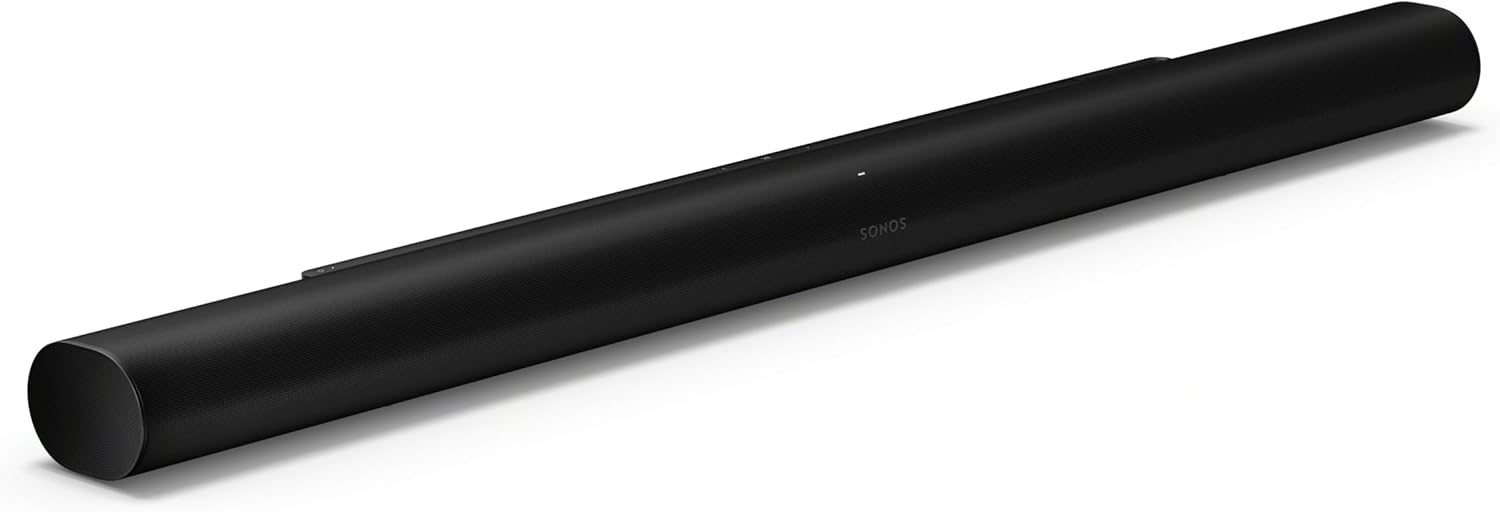
Sonos Arc Ultra Soundbar with Dolby Atmos and Voice Control
Pros
- TrueAtmos processing produces convincing overhead Atmos effects
- Trueplay room correction automatically calibrates to your space
- Integrates cleanly into a multi-room Sonos whole-home audio setup
- Alexa and Google Assistant built in with responsive microphones
- Polished Sonos app with a consistent update track record
Cons
- No subwoofer included, add $499+ for satisfying bass impact
- No rear speakers in the base configuration
- Expensive for a single-bar setup compared to full packages at this price
Price as of Feb 27, 2026 — see current price on Amazon.
Best Mid-Range: Sonos Beam Gen 2
The Sonos Beam Gen 2 exists for a specific kind of buyer: someone with a smaller room or TV, who wants Dolby Atmos support and Sonos app integration without the flagship price. At around $449 for the 36-inch bar, it fits under 42-inch to 55-inch TVs without dominating the entertainment unit.
Atmos processing on the Beam Gen 2 is real, not just a badge. It uses the same TrueAtmos-style processing as the Arc Ultra, just with fewer drivers and less room coverage. In a small to medium living room or a bedroom setup, the Atmos height effects are noticeable on compatible content. Dolby Atmos passthrough works correctly from both HDMI eARC and optical connections.
The Beam Gen 2 also supports Apple AirPlay 2 natively, which no Samsung soundbar in this guide does. If you have an iPhone or iPad and want to airplay audio directly without touching the remote or the Sonos app, it works reliably. The HDMI eARC connection handles audio passthrough cleanly from any TV with that port. Add a Sonos Sub Mini later to complete the setup if you want more bass.
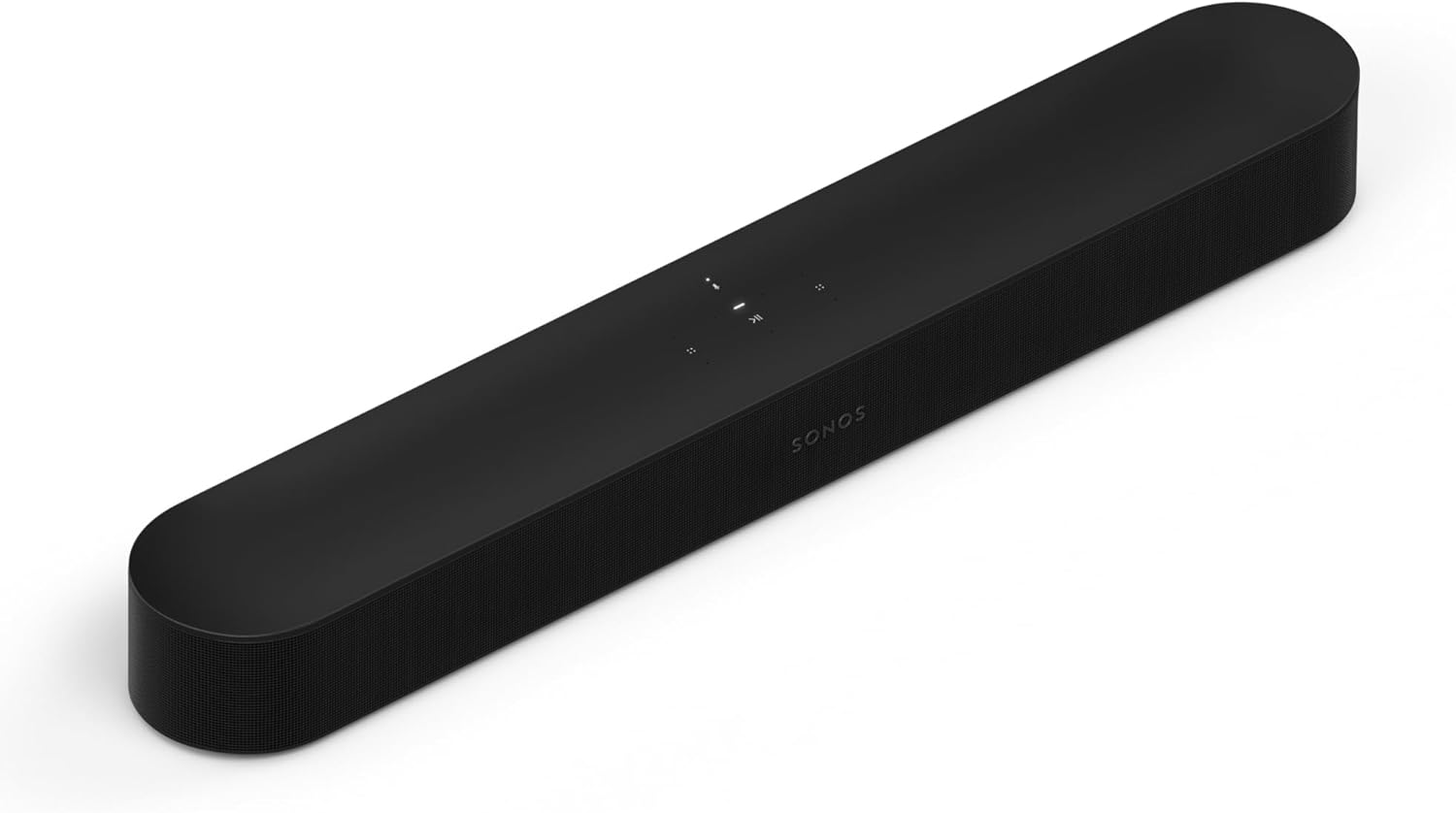
Sonos Beam Gen 2 Soundbar with Dolby Atmos
Pros
- Dolby Atmos with real TrueAtmos processing, not just a label
- Compact 36-inch form factor fits under smaller TVs
- Apple AirPlay 2 for direct iPhone/iPad audio streaming
- Integrates with existing Sonos multi-room audio setups
- Trueplay room correction via the Sonos app
Cons
- No subwoofer included, bass extension is limited without an add-on
- Only 3.0.2 channels versus the Arc Ultra's more immersive layout
- No included rear speakers for full surround sound
Price as of Feb 27, 2026 — see current price on Amazon.
Best Value Surround: LG S90TR
LG's S90TR is the overlooked pick in this guide and probably the smartest buy if you own an LG TV. It is a 7.1.3 channel system that includes the soundbar, a wireless subwoofer, and two rear wireless speakers in the box, at around $799. That is a complete surround sound package for $200 less than the Sonos Arc Ultra, which does not include anything but the bar itself.
The S90TR connects to LG OLED and QLED TVs via WOW Orchestra, LG's version of Samsung's Q-Symphony, which synchronizes the TV speakers with the soundbar for a combined speaker array. For LG TV owners, this is a meaningful upgrade in spatial imaging over a soundbar working alone. Dolby Atmos is supported via dedicated up-firing drivers, and MERIDIAN Audio technology handles the signal processing.
Its HDMI eARC port handles passthrough from any source cleanly. AI Room Calibration Pro measures your space and adjusts the EQ for the rear speakers based on their physical placement, which is a useful practical feature for rooms where the rear speakers cannot be placed symmetrically. The subwoofer is wireless and pairs automatically. Build quality is solid without being premium, which is an expected trade-off for the price.
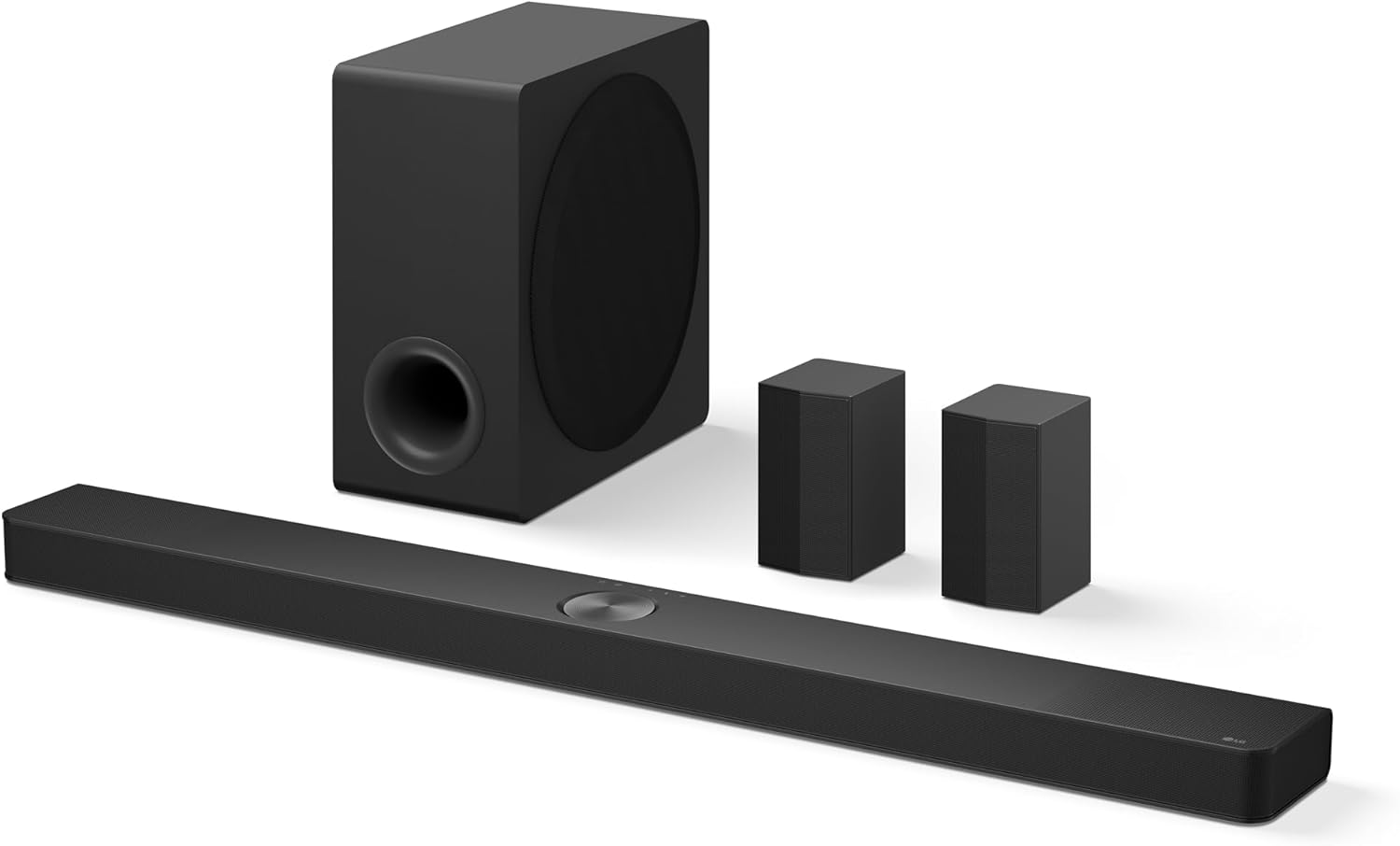
LG S90TR 7.1.3-Channel Soundbar with Rear Speakers and Wireless Subwoofer
Pros
- Complete 7.1.3 surround setup with rear speakers and subwoofer included
- WOW Orchestra syncs with LG TVs for a unified speaker array
- AI Room Calibration Pro adjusts for real-world speaker placement
- Dolby Atmos with dedicated up-firing drivers in the bar and rear units
- MERIDIAN Audio signal processing improves dialogue and spatial imaging
Cons
- WOW Orchestra integration is exclusive to LG TVs
- Build quality is functional but not as premium as Sonos or Samsung flagship
- Sonos ecosystem features not available if you use non-Sonos components
Price as of Feb 27, 2026 — see current price on Amazon.
Best Budget: Amazon Fire TV Soundbar
The Amazon Fire TV Soundbar does not pretend to be something it is not. It is a 2.0 channel soundbar with DTS Virtual:X spatial audio processing, Dolby Audio support, and deep Fire TV integration, for $99. At that price, the relevant comparison is not Sonos. The relevant comparison is your TV's built-in speakers, which it beats convincingly.
Fire TV integration is the real differentiator. The soundbar syncs with your Fire TV remote, so the same remote controls both the TV and the soundbar volume without needing to switch inputs or configure anything. If you already use a Fire TV Stick, Fire TV Cube, or a built-in Fire TV set, the setup is essentially automatic. HDMI eARC and optical inputs are both included.
Bass is handled via a passive radiator on the back of the bar rather than a dedicated subwoofer, and it performs better than expected for a 99-dollar unit. Action film bass will not rattle the walls, but dialogue is noticeably clearer than any TV speaker this side of a thousand dollars. If you want better audio without spending more than you paid for your TV remote, this is the pick.
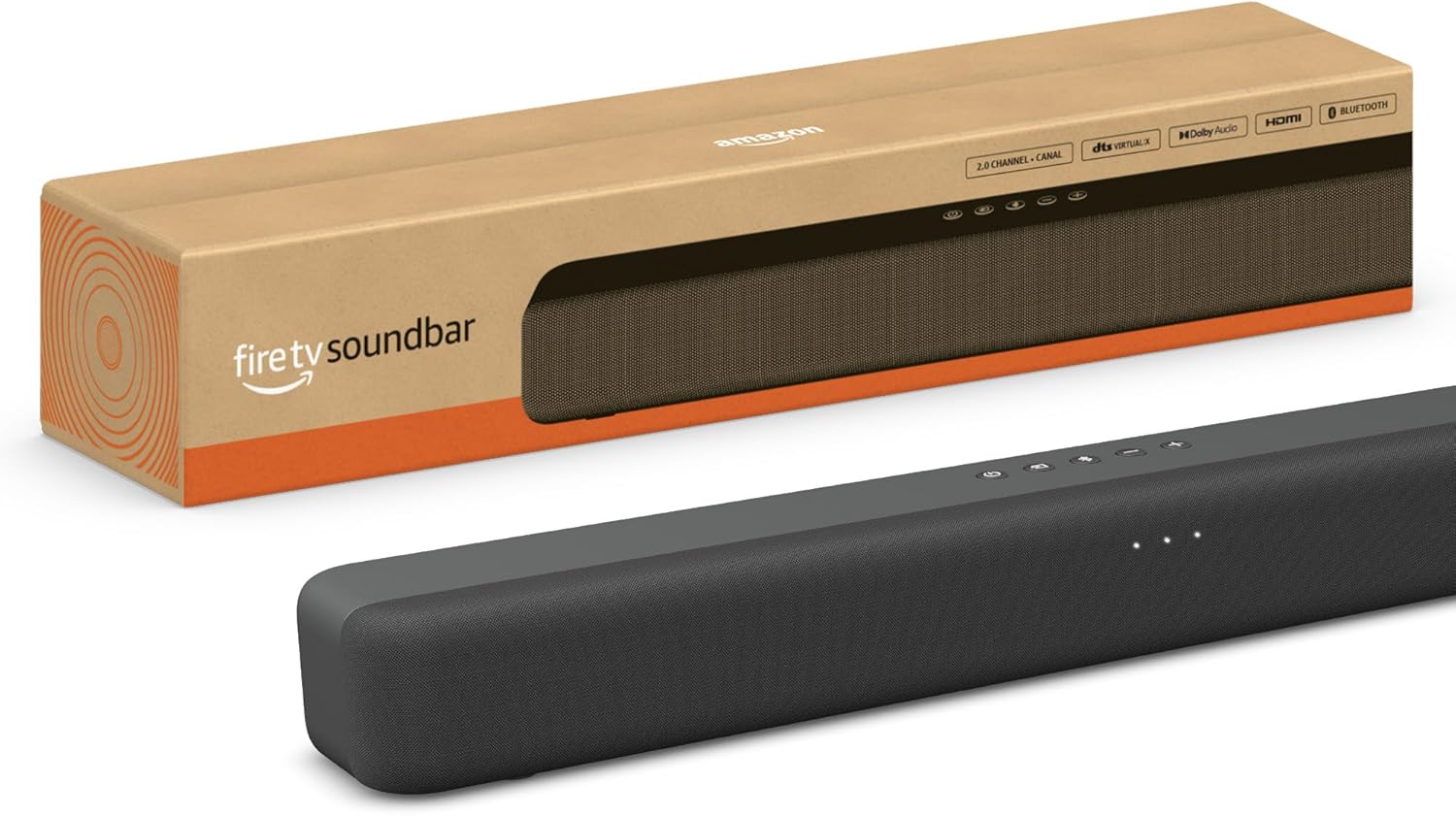
Amazon Fire TV Soundbar
Pros
- Syncs automatically with Fire TV remotes for unified volume control
- HDMI eARC and optical inputs both included at this price
- Passive radiator delivers better bass than typical flat-bar competitors
- DTS Virtual:X adds some spatial width to stereo content
- Easy setup with no configuration required for Fire TV users
Cons
- 2.0 channels only, no true surround or overhead Atmos processing
- No subwoofer output or rear speaker expansion capability
- Bass performance is limited compared to any soundbar with a dedicated subwoofer
Price as of Feb 27, 2026 — see current price on Amazon.
How to choose the right soundbar
Channel count explained
Soundbar channel counts follow the same convention as AV receiver setups: the first number is the main channels (left, center, right, and any rear speakers), the second is dedicated subwoofer channels, and the third (if present) is up-firing height channels for overhead Atmos effects.
A 2.0 soundbar like the Fire TV Soundbar is just a stereo bar, no subwoofer, no height. A 3.1 is a bar plus subwoofer. A 5.1.2 adds rear speakers and two up-firing drivers. An 11.1.4 like the Samsung HW-Q990F is a full surround package with four up-firing drivers creating a genuine height layer. More channels generally means better spatial immersion, but only if your room is large enough for the rear speakers to matter.
Does Dolby Atmos actually work on a soundbar?
Yes, but with important caveats. True Atmos requires physical up-firing or side-firing drivers to bounce height sound off the ceiling. Soundbars with those drivers (the Arc Ultra, HW-Q990F, S90TR, and Beam Gen 2 all qualify) produce a genuine height effect, though it is less convincing than a ceiling-mounted speaker array. The effect depends on your ceiling height and material: 8 to 10-foot flat ceilings work best, vaulted or very high ceilings reduce the effect.
"Dolby Atmos" badges on 2.0 or 3.0 bars usually mean Dolby Atmos passthrough, meaning the bar sends the Atmos bitstream to a compatible TV or decoder rather than processing it internally. This is a legitimate feature for pass-through purposes but does not add height.
HDMI eARC vs optical
HDMI eARC (Enhanced Audio Return Channel) should be your first choice for connecting a soundbar to a TV. It supports lossless Dolby Atmos and DTS:X audio formats that optical connections cannot carry. Optical cables cap out at Dolby Digital 5.1, which means you lose Atmos overhead information entirely. Every soundbar in this guide includes HDMI eARC. Use it if your TV has the port.
TV-specific sync features
Samsung's Q-Symphony and LG's WOW Orchestra both allow the soundbar to work alongside the TV speakers rather than replacing them. This is a real audio quality improvement when pairing the right brands, but it requires a compatible TV from the same manufacturer. If you have a Samsung TV, the HW-Q990F's Q-Symphony integration is a meaningful bonus. If you have an LG TV, the S90TR's WOW Orchestra is worth seeking out. If you have a Sony, TCL, or any other brand, ignore these features entirely and evaluate the soundbar on its standalone performance.
How much should you spend?
For most living rooms, the sweet spot is $400 to $800 for a bar-and-subwoofer setup or a complete 5.1+ package. Below $200, you get better audio than your TV speakers but not a transformative upgrade. Above $1,000, the improvement curve flattens and you are paying for ecosystem integration, rear speakers, and specific TV brand synergy. The Sonos Beam Gen 2 at $449 is the best standalone bar for most people. The LG S90TR at $799 is the best complete system if you want true surround without buying add-ons separately.
Frequently Asked Questions
Frequently asked questions
- Do I need a subwoofer with my soundbar?
- For movies and music with real bass content, yes. A subwoofer handles frequencies below 80Hz that no soundbar bar can reproduce on its own. The Amazon Fire TV Soundbar and Sonos Beam Gen 2 have good low-end extension for the category but will feel thin during action film explosions or bass-heavy music. The Samsung HW-Q990F and LG S90TR include wireless subwoofers in the box.
- What is the difference between Dolby Atmos and DTS:X?
- Both are object-based surround sound formats that use metadata to place sounds in a three-dimensional space, including height channels above the listener. Dolby Atmos is more widely supported on streaming platforms like Netflix, Disney+, and Apple TV+. DTS:X is common on Blu-ray discs. A soundbar that supports both handles nearly all content sources. For streaming, Dolby Atmos support matters more in practice.
- Can I use a Sonos soundbar with a non-Sonos TV?
- Yes. Sonos soundbars connect via HDMI eARC or optical input and work with any TV brand. The TrueAtmos processing and Trueplay room calibration features work regardless of TV manufacturer. The main things you lose without a matching-brand TV are Samsung Q-Symphony or LG WOW Orchestra sync. Everything else works normally.
- How important is room size when choosing a soundbar?
- Very important for soundbars with rear speakers. A 7.1.3 or 11.1.4 system fills a large room well, but in a small bedroom or apartment, the rear speakers end up too close to the listening position to create a natural surround effect. For rooms under 200 square feet, a bar-and-subwoofer setup like the Sonos Beam Gen 2 plus Sub Mini is more appropriate than a full surround package.
- Is a soundbar worth it if I already have good TV speakers?
- Premium TVs like the LG C5 and Sony BRAVIA 8 II have better-than-average built-in audio, but they still cannot produce real bass or convincing surround effects from a flat panel. A soundbar adds low-end extension, spatial separation, and dialogue clarity that built-in TV speakers cannot replicate regardless of quality. Even a mid-range soundbar makes a noticeable difference for TV watching.
The verdict
The Samsung HW-Q990F is the best soundbar you can buy if you want a complete home theater experience and own a compatible Samsung TV. Q-Symphony integration and the included rear speakers make it a genuine surround system in a package that requires no additional purchases.
The Sonos Arc Ultra is the better choice if you are already in the Sonos ecosystem or want best-in-class smart soundbar features without the Samsung TV requirement. Budget for a Sub Mini to complete the package.
For most people, the LG S90TR offers the best combination of complete surround sound and reasonable price, particularly for LG TV owners. The Sonos Beam Gen 2 is the right pick for smaller rooms or anyone who prioritizes Apple ecosystem integration over complete surround.
If your only goal is to stop suffering through TV speakers, the Amazon Fire TV Soundbar at $99 delivers exactly what it promises.
For more home theater recommendations, see our Best TVs 2026 guide for screen pairings that match these soundbars. If audio is your priority and you want personal listening options alongside a room setup, our Best Noise-Cancelling Headphones Under $200 guide covers the best portable alternatives. Looking for gift ideas that include soundbars and streaming devices? Our Best Tech Gifts 2026 guide has budget-range options for every tier. And if you're not yet sure a soundbar is the right shape of purchase at all, our guide to soundbars vs bookshelf speakers for a TV works through that decision first.
How We Pick
We pick products by combining spec-level research, price checks, trusted third-party benchmarks, and owner sentiment from high-signal sources.
- Performance and real-world value in the category this guide targets
- Price-to-performance and deal consistency over recent pricing windows
- Build quality, reliability patterns, and known long-term issues
- Recommendation refresh cadence to keep these picks current
Author
TheTechSearch Editorial Team
Independent product reviewers & PC builders
We compare real-world specs, reviews and owner reports, price trends, and user feedback to recommend gear that actually makes sense to buy.