Gaming Laptop vs Desktop PC: Which Should You Buy in 2026?
Gaming laptop vs desktop PC in 2026: who should buy which, what you give up either way, and our top picks for both. Expert picks, pros and cons, and side-by-...
As an Amazon Associate we earn from qualifying purchases made through our links — this doesn't affect our picks.
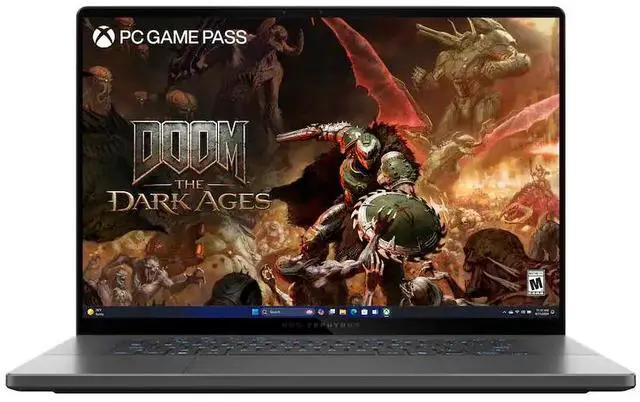
ASUS ROG Zephyrus G16 (2026), RTX 5070
Our top recommendation for this category
Price as of Sep 2, 2026 — see current price on Amazon.
Here's the short answer. If you ever need to take your gaming machine somewhere (college dorm, friend's place, traveling to work on a game dev project), buy a laptop. If it stays on your desk 100% of the time, buy a desktop. Performance per dollar still favors the desktop by a meaningful margin in 2026, but the gap has shrunk enough that a gaming laptop is no longer a real compromise for most people.
That said, there are wrong answers here depending on your situation. I've seen people buy desktops when they're moving every year, and people buy laptops when they never leave the house and then wonder why their RTX 5070 runs hotter than expected. So let me walk through the actual tradeoffs.
The Performance Gap Is Real, But Smaller Than You Think
For years the rule was simple: mobile GPU equals desktop GPU from one or two tiers lower. That's still true in 2026, though less brutally so. NVIDIA's Blackwell mobile GPUs (RTX 5060 through 5070 Ti) operate at lower TDP than their desktop counterparts, which limits sustained performance under load.
A rough translation: a laptop with RTX 5070 will trade blows with a desktop RTX 5060 Ti in most gaming benchmarks. At 1440p, the gap sits around 15-25% depending on the title. At 1080p, it narrows to 5-15%. For esports games like Valorant or CS2, you'll barely notice it.
Where laptops genuinely struggle is sustained heavy workloads. Run demanding games for 90 minutes and laptop thermals start throttling things down. Good laptops handle this better than they did three years ago, but a desktop with tower cooling just doesn't have this problem.
The Price Math: What You're Actually Paying
Same GPU, two form factors, two very different prices. In 2026, roughly:
- RTX 5060 laptop: $999 to $1,299
- RTX 5060 desktop (prebuilt): $699 to $899
- RTX 5060 Ti laptop: add $150-300
- RTX 5060 Ti desktop (prebuilt): $899 to $1,099
You're paying a 30-50% premium for the portable form factor. For some people that's obviously worth it. For others, that premium buys a better desk, monitor, and chair, which affects daily comfort more than frame rates do.
Desktops also have a long-term cost advantage: when the RTX 6000 series drops in a few years, you swap the GPU for $300-400 and your system is current again. With a laptop, you buy a new laptop.
| Gaming Laptop | Gaming Desktop | |
|---|---|---|
| Starting price | ~$899 | ~$699 |
| GPU performance (same tier) | Good | Excellent |
| Thermals under sustained load | Gets warm | Stays cool |
| Upgradeable parts | RAM + SSD only | GPU, CPU, RAM, SSD |
| Built-in display | Yes (165-240Hz) | No (monitor required) |
| Battery | 3-5 hrs gaming | None |
| Portability | Yes | No |
| Multi-monitor support | 1-2 external | 2-4 easily |
When a Gaming Laptop Makes More Sense
You're in college or move every year. A desktop in a dorm means hauling a tower, monitor, keyboard, and mouse to a new place every August. A laptop handles everything in one bag. A 16-inch gaming laptop runs 1.9 to 2.5kg. That matters at 1am move-in day.
You want one device for everything. Many gaming laptops double as solid work machines with OLED displays and decent battery life for class or meetings. A separate desktop means buying a monitor, and then your gaming rig just sits there idle while you're at work.
You play in shorter sessions. Long thermal stress tests aren't your use case. Casual gaming in 1-3 hour bursts is exactly what laptops are tuned for.
You have limited space. Studio apartment. Shared room. A 15-inch laptop fits anywhere a desktop tower plus monitor cannot.
When a Desktop Makes More Sense
You game at a fixed desk, always. If the only place you ever game is one specific desk in your home, you're paying a 40% portability premium for portability you don't use.
You want the best possible frame rates. A desktop RTX 5070 hits around 180fps in 1440p games that struggle to hit 140fps on the laptop version of the same GPU. If you care about high-refresh gaming seriously, desktop wins.
You're building a long-term setup. A desktop you buy in 2026 can run through 2028 with a single GPU swap. Gaming laptops get replaced, not upgraded.
You want multi-monitor. A desktop handles three 1440p monitors without breaking a sweat. Most gaming laptops cap out at two external displays and one laptop panel, and the GPU allocation gets complex.
Our Recommended Picks
Prices below are what Amazon listed on September 19, 2026. Worth saying plainly: both of these are running well above the ranges in the section above. Memory and GPU supply has been tight all quarter and prebuilt and laptop pricing has moved with it, so if you can wait a few months, waiting is a real option.
Best Gaming Laptop
ASUS ROG Zephyrus G16 (2026), RTX 5070
Pros
- 2.5K 240Hz OLED display is reference-quality
- RTX 5070 with 2TB SSD for serious gaming and storage
- 16mm thin chassis runs cooler than most gaming laptops this slim
- WiFi 7 and Thunderbolt 4 for future-proofing
Cons
- $2,569.95 is a lot of money for a laptop GPU that's a tier behind desktop
- 16GB RAM on a laptop at this price should be 32GB
- Eclipse Gray fingerprints easily
Price as of Sep 2, 2026 — see current price on Amazon.
The G16 is genuinely one of the best laptops ASUS has built. That 240Hz OLED used to demand compromises elsewhere in the machine, and it doesn't anymore. The 16mm chassis stays cooler than most laptops this thin, and Thunderbolt 4 plus WiFi 7 means it'll still dock cleanly in three years.
Here's the honest caveat. At $2,569.95 you are paying roughly $1,080 more than the desktop below, for a machine whose GPU will lose to that desktop under sustained load. Buy the G16 because you need the portability and want the best panel on a laptop, not because you're chasing frames. If the machine never leaves your desk, this is the wrong purchase and it isn't close.
Best Value Gaming Desktop
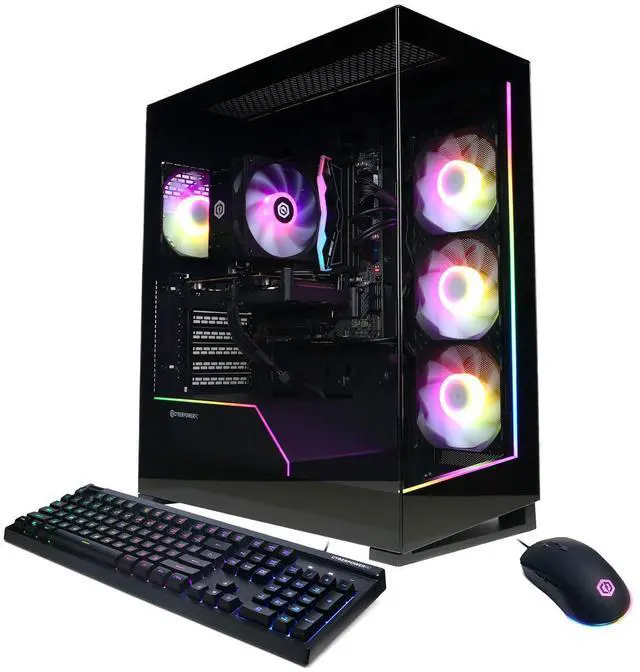
CyberPowerPC Gamer Xtreme, RTX 5060 Ti
Pros
- RTX 5060 Ti outperforms laptop RTX 5070 at sustained loads
- 2TB NVMe SSD, no storage anxiety
- Easy to open and upgrade later (GPU, RAM)
- Still roughly $1,080 cheaper than the laptop above
Cons
- Intel Core i5-14400F is showing its age, not a 2026 CPU
- 16GB DDR5 is workable but add another 16GB eventually
- Priced well above the $949 it sold for earlier this year
- RGB marketing is strong with this one
Price as of Sep 2, 2026 — see current price on Amazon.
This CyberPowerPC gives you an RTX 5060 Ti, a card that delivers 120-180fps at 1440p in most games and handles 4K at medium settings. The i5-14400F CPU is an older chip, but gaming is GPU-bound enough that it doesn't meaningfully bottleneck the GPU in current titles. Build quality is decent, the case has good airflow, and every component is accessible when you want to upgrade in two years.
It was $949 earlier this year and it's $1,486 now. Annoying. It's still the better buy of the two if you game at a desk, because it runs cooler, sustains higher frame rates, and doesn't throttle after an hour.
Budget Laptop Pick: Lenovo Legion 5i Gen 10
On paper this is the strongest laptop value here: a 15.1-inch PureSight OLED at 165Hz, an RTX 5060 with DLSS 4, and a Core Ultra 7 255HX, at about $1,099. Lenovo's thermals on the Gen 10 are a real step up from the Gen 8, which matters for long gaming sessions.
Stock comes and goes, so check the listing before you plan around it. If it's out, the G16 above is the alternative, at more than double the price.
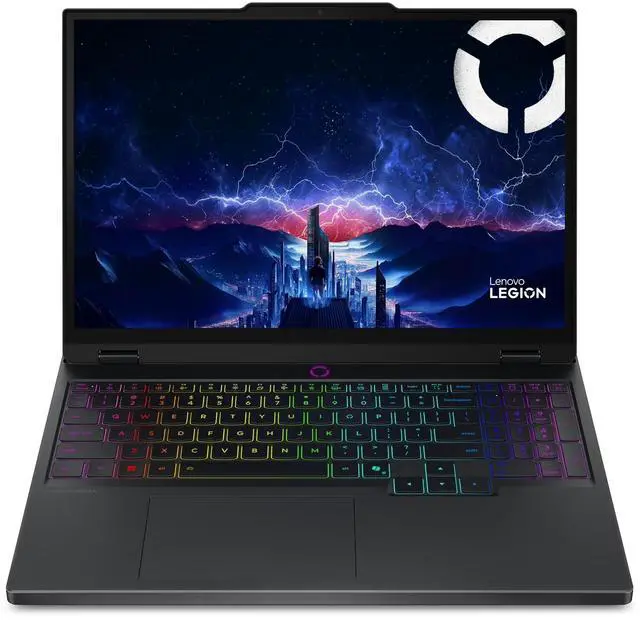
Lenovo Legion 5i Gen 10 (2026), RTX 5060
Pros
- 15.1-inch PureSight OLED at 165Hz is genuinely beautiful
- RTX 5060 with DLSS 4 handles 1440p well
- Intel Core Ultra 7 255HX handles heavy workloads without complaining
- Was reasonably priced for a 2026 OLED gaming laptop
Cons
- Stock comes and goes, so check availability first
- 512GB SSD fills up fast, budget for an upgrade
- Fan noise audible under heavy gaming load
- 16GB RAM is workable but not generous
Price as of Sep 2, 2026 — see current price on Amazon.
FAQs
Frequently asked questions
- Can a gaming laptop handle both college work and gaming?
- Absolutely. Modern gaming laptops have OLED displays and enough CPU horsepower to handle video editing, coding, or document work between gaming sessions. The Core Ultra 7 or Ryzen 7 chips in mid-range gaming laptops are genuinely fast for productivity tasks.
- Is the performance gap between laptop and desktop GPUs getting smaller?
- Somewhat. NVIDIA's Blackwell architecture closed the gap compared to Ampere, but a meaningful performance difference remains, roughly 15-30% favoring the desktop at sustained loads. The gap is smaller at 1080p and in esports titles, larger at 4K and in GPU-heavy titles like Cyberpunk 2077.
- Should I buy a gaming laptop or desktop for under $1,000?
- At that budget, desktop delivers significantly more GPU performance. A $799-999 prebuilt desktop with an RTX 5060 Ti outperforms a $999 gaming laptop with an RTX 5060 in sustained gaming. Buy the laptop only if portability is non-negotiable.
- Can I connect a gaming laptop to an external monitor?
- Yes, and most people who game seriously at home do this. An external 1440p or 4K monitor through HDMI 2.1 or USB-C is easy to set up. Just know you're still running the laptop GPU and not getting desktop-tier sustained performance.
- How long does a gaming laptop last before it feels outdated?
- Realistically 3-5 years depending on how aggressive you want to be with settings. A 2026 RTX 5060 laptop will handle 1440p medium-to-high settings through 2028-2029 in most titles. Desktops last longer because you can swap the GPU; laptops you replace entirely.
- Is cooling really that different between laptops and desktops?
- Yes, meaningfully. Desktops with good cases and tower coolers maintain consistent temperatures under sustained load. Gaming laptops manage thermals well for 30-60 minute sessions but will throttle to some degree during marathon gaming. It's not a dealbreaker, but it's real.
Bottom Line
Desktop beats laptop on performance per dollar in 2026, full stop, and the current pricing makes that gap wider than usual. If you're a student, a small-space dweller, or someone who moves their gaming setup around, the ROG Zephyrus G16 is an excellent machine that won't leave you disappointed, as long as you've made your peace with $2,569.95. Game at a fixed desk and never carry the thing anywhere? The CyberPowerPC Gamer Xtreme gives you more GPU, cooler temps, and an upgradeable platform for about $1,080 less. Know which situation you're in, and the decision basically makes itself.
How We Pick
We pick products by combining spec-level research, price checks, trusted third-party benchmarks, and owner sentiment from high-signal sources.
- Performance and real-world value in the category this guide targets
- Price-to-performance and deal consistency over recent pricing windows
- Build quality, reliability patterns, and known long-term issues
- Recommendation refresh cadence to keep these picks current
Author
TheTechSearch Editorial Team
Independent product reviewers & PC builders
We compare real-world specs, reviews and owner reports, price trends, and user feedback to recommend gear that actually makes sense to buy.